Your revenue team already asks Claude and ChatGPT for help with spreadsheets and reports. Plug Rate Pulse Pro in and they can ask the market directly: who moved, who followed, what an event is doing to rates, where peak season is pricing a year out. Your assistant pulls the numbers from Rate Pulse and does the analysis in front of you.
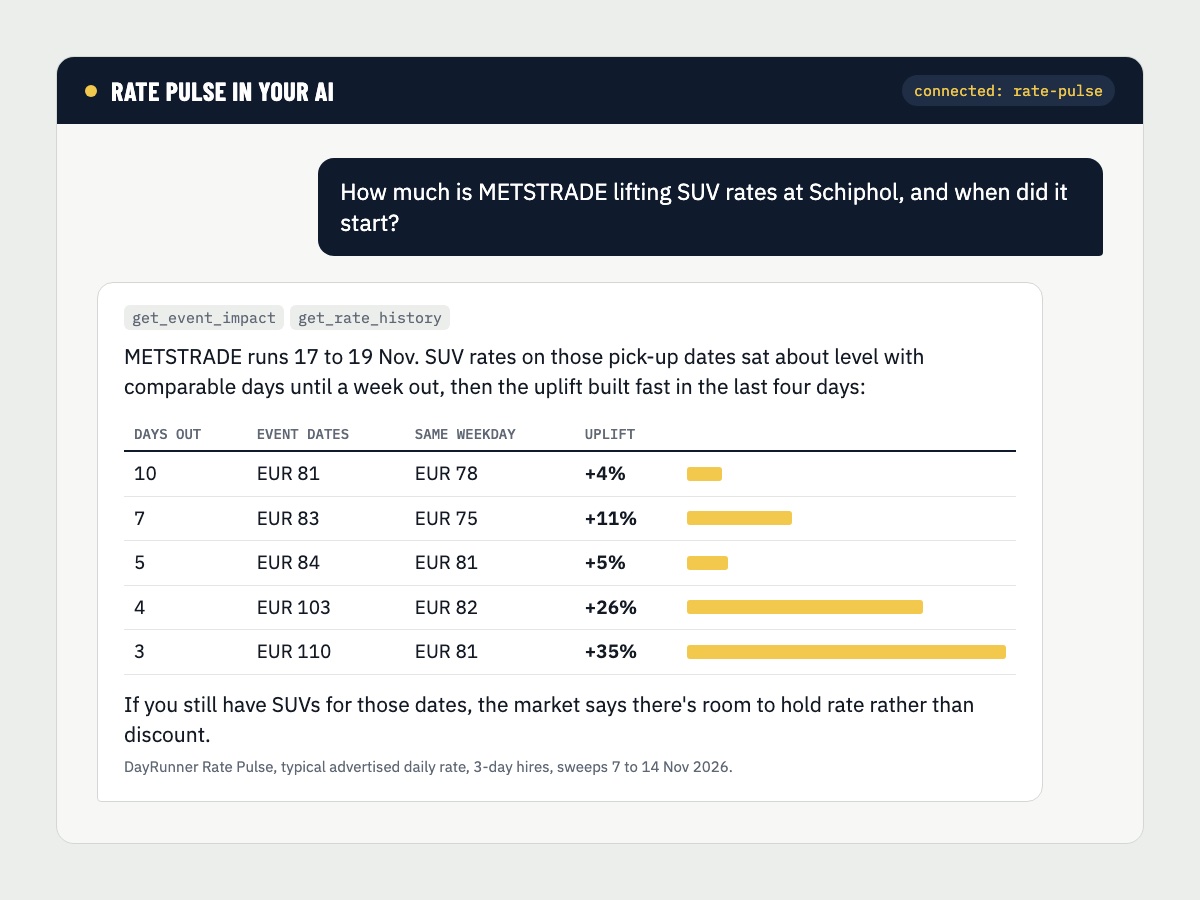
An example answer built from real Rate Pulse data. The uplift on METSTRADE dates went from 4% ten days out to 35% three days out.
Ask it like a colleague
"Which brands cut SUV rates at Queenstown this week, on the same pick-up dates, and who followed them?"
"Show the 7-sweep moving average for compacts at Sydney and tell me whether the market ahead is firming."
"How much is METSTRADE lifting rates at Schiphol, and when did the uplift start?"
"Where is New Year pricing at Auckland against late January, and is it moving?"
"Compare compact rates across every airport we operate in, week on week."
"Which brands are rated above 9 at Christchurch, and how do they price against the market?"
What's in it
Every sweep, kept. Every brand's advertised rate by car type and pick-up day, every morning since 7 Nov 2026, at all 38 airports.
A year ahead. Weekly pick-up dates out to three months and monthly out to twelve, each re-searched every week, so you see peak-season pricing open and move.
Moving averages. The forward market level each morning and its 7-sweep (or any) moving average, per airport and car type.
Price point changes. Every brand move compared like for like on the same pick-up dates, with the morning it happened.
Who's moving and when. Which brands move first, how often and by how much.
Who's following who. Leader and follower pairs: when one brand moves and another matches within a few days.
Event analytics. Events and public and school holidays a year ahead, with the price uplift on event dates against comparable days and how it built as the date got closer.
Ratings vs price. Every brand's customer rating and sub-scores next to its price index.
38 airports. Advertised rates from Rentalcars.com at every airport on your plan. Your own branches, other booking sites and brand websites are part of our automation and consulting work.
How to connect
Get your link
Start Rate Pulse Pro, free for 14 days. Your private connector link is in your dashboard as soon as it builds.
Add it to your assistant
In Claude, add a custom connector and paste the link. In ChatGPT, add it as a custom connector (MCP) with no extra sign-in. Other assistants: add it as a remote MCP server.
Ask
Start with "What airports can you see in Rate Pulse?" and go from there.
Built for revenue people
No dashboard to learn and no exports to stitch together. Your assistant can chain the tools: pull the moves, line them up against events, check ratings, and write the summary for your Monday meeting. You can still open the numbers behind every answer.
Where it leads
Once your team is asking the market questions every day, the next step is usually putting your own bookings next to it. That's our revenue management work: your pace and utilisation against the market, with rate recommendations and the reason for each.
Model Context Protocol, the standard way to plug a data source into an AI assistant. Claude, ChatGPT and a growing list of other assistants support it. You add our link once and your assistant can query Rate Pulse whenever you ask it something about the market.
Which assistants does it work with?
Claude (web, desktop and Claude Code), ChatGPT on plans that allow custom connectors, and any other assistant or agent framework that supports remote MCP servers over HTTP.
Can it change anything?
No. Every tool is read-only. It can't see your bookings, your systems or anything outside Rate Pulse.
Is my access private?
Yes. You get your own key, shared only with you. It's limited to the airports on your plan, we can turn it off any time, and we log usage so you can see what's being asked.
What does it cost?
It's how you use Rate Pulse Pro, which is from US$29 a month for one airport. Add airports as you need them. Month to month.